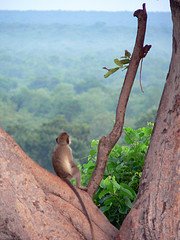
AFP: Bounty for 'gangster' monkeys terrorising tourists at Cambodian temple
They acknowledge that there are just a few aggressive animals - about 1% or so of the total there. There's no evidence of a program of capture here, or other humane options. What of the 197 monkeys who are "afraid" and not causing problems? Will they be killed by mercenaries looking for a few bucks?
Oct 3, 2007
| [+/-] |
AFP: Bounty for 'gangster' monkeys terrorising tourists at Cambodian temple |
Sep 25, 2007
| [+/-] |
(Alleged) Gorilla trafficking ring busted |
News | Africa - Reuters.com
From the article:
"Poachers and gunmen have killed at least nine mountain gorillas this year and a possible revival in trafficking poses another threat to the mighty beasts, of whom just 700 remain, spread between Democratic Republic of Congo, Uganda and Rwanda."
Read more online: Congo rangers break suspected gorilla traffic ring
Sep 11, 2007
| [+/-] |
Monkey Business in Malaysia |
Controversy surrounding the capture and export of long-tailed macaques for meat and experimentation continues. The status and scope of the ban have been described variously. What is certain, is that the fate of the monkeys who have been captured or may soon be captured will be miserable. This news article summarizes some of the key issues.
The Malaysia Star has a brand new article that is rich with facts and figures about how many monkeys are imported into the US and how many may be subject to capture, sale and misery if it is not possible to negotiate on alternative approaches such as community education, sterilization and other options. Dr. Shirley McGreal, Founder and Chairwoman of the International Primate Protection League cuts right to the chase when talking about the suffering monkeys endure in experimentation. And given the numbers reported, it could happen on an enormous scale.
McGreal said Malaysians needed to know that indigenous monkeys from the country were likely to be sold to these labs.
“They will suffer horribly during the laboratory experiment. There is no way of conducting research humanely when dealing with biological warfare agents.”
As long-tailed macaque is listed on Appendix II of the Convention on International Trade in Endangered Species (Cites), Perhilitan has produced a non-detrimental finding (NDF) to show that the trade will not have a deleterious effect on the species’ survival.
According to the NDF, there are 258,406 macaques in urban areas and 483,747 at forest fringes.
These figures represent more than 10 and 20 times respectively of the total number of monkeys imported into the US in 2006.
Full text of the article Monkey Business.
Related article: Making a quick buck
Aug 31, 2007
| [+/-] |
The AWA: Fostering mediocrity and suffering |
Many moons ago when I worked at an unnamed insurance company, they actually did time motion studies of the workers to figure out how long it “should” take to adjust a hospital claim, for example. They’d send a special engineer down to watch you with a stopwatch and check sheet. “Now tell me what you do when you get a durable medical equipment claim? How many do you see each week? Why did you route that claim for utilization review?”
The more I was treated like a cog, and the less my thinking was valued, the more I performed like the “average” employee - something I was not. I stopped wearing suits and volunteering to be on committees, taking extra classes, etc. I started wearing stretch pants and sweaters and paced myself so that I did exactly the number of things that I needed to do to be “within range.” I volunteered for lay offs when they announced a merger. And when I didn’t get that lay off, I staged even more of “slow down.” Average is easy, but it's boring and soul-killing. Eventually I was released from Bare Minimum Corp. I embarked on 10 years of education - where life can be about more than "average."
I’m really not interested in working in an environment like that ever again. Any system based on achieving minimum performance will consistently produce minimum performance. Take the Animal Welfare Act for example. The Act more or less states that if facilities make cages this big, keep this paper work, file these reports, etc., they are fine. There’s no “excellent,” there’s just “no deficiencies.” When performance targets are lame to begin with, as they are with the Act, we end up a long way from excellence.
We might get consistent results, but it's not assured. What is assured is that we will never get newer, bigger, better results. Consistent crap is crap all the same. The top ten percent of shit is shit. Why set your organization up for a whole lotta "average?" Hoping that it will lead to success or excellence is just foolish.
Aug 26, 2007
| [+/-] |
Sneak peek: Editorial board on animal experiments and facilities at UW |
The Seattle PI has published yet another editorial piece regarding the animal experimentation at the UW, including their ongoing probation with their accrediting agency, and investigations and criticisms from governmental investigators.
The PI begins by addressing the President and The Regents of the UW. The piece goes on to talk about the billions of dollars (and yes that's billions with a B) that the university has in its coffers:
“Some degree of animal experimentation figures into grants involving $250 million or more. It was institutionally neglectful or worse to let some facilities become so derelict as to prompt replacement demands from the national accrediting organization." [emphasis added]
The board is not about to let the U get away with actions it apparently thinks are despicable. The language is strong - and rightfully so. See the full text here:
Animal Research: Make the Grade .
Subscribe to:
Posts (Atom)